Between Conero and Gran Sasso is an 8-day tour through the Marche and Abruzzo regions, a journey combining art cities, historic villages, natural landscapes, and authentic traditions. The itinerary passes through Ancona, Conero Park, Portonovo, Corinaldo, Urbino, Fabriano, Loreto, Macerata, Ascoli Piceno, Civitella del Tronto, Atri, Santo Stefano di Sessanio, L’Aquila, Campo Imperatore, Chieti, and Sulmona. Between spectacular coastlines, medieval villages, UNESCO sites, natural parks, and typical local flavors, the tour offers a complete experience discovering the authentic charm of central Italy.
Arrival in Ancona, transfer to hotel,
dinner and overnight stay.
Ancona – Conero Park – Portonovo and Corinaldo – Half board at hotel. Departure for Ancona, an ancient art city built in an amphitheater on Mount Conero. Guided tour of the historic center: the Cathedral of San Ciriaco, in a commanding position, the Loggia dei Mercanti, the Governor’s Palace, the Fountain of the Thirteen Spouts, symbol of the city, and the Lazzaretto, better known as the Mole Vanvitelliana. Continue toward the Conero Riviera, one of the most evocative corners of the Marche region. Arrival in Portonovo and walk through the village, pearl of Conero, nestled in an enchanting bay famous for moscioli, a variety of wild mussels. In the afternoon, visit Corinaldo, one of the Most Beautiful Villages in Italy, protected by mighty walls. Through the Porta Nova and the “Piaggia,” a stairway overlooked by characteristic brick houses, visit the village pervaded by a medieval atmosphere: the Pozzo della Polenta, the Sanctuary of Santa Maria Goretti, where the relics of the Saint are preserved, and the Goldoni Theater.
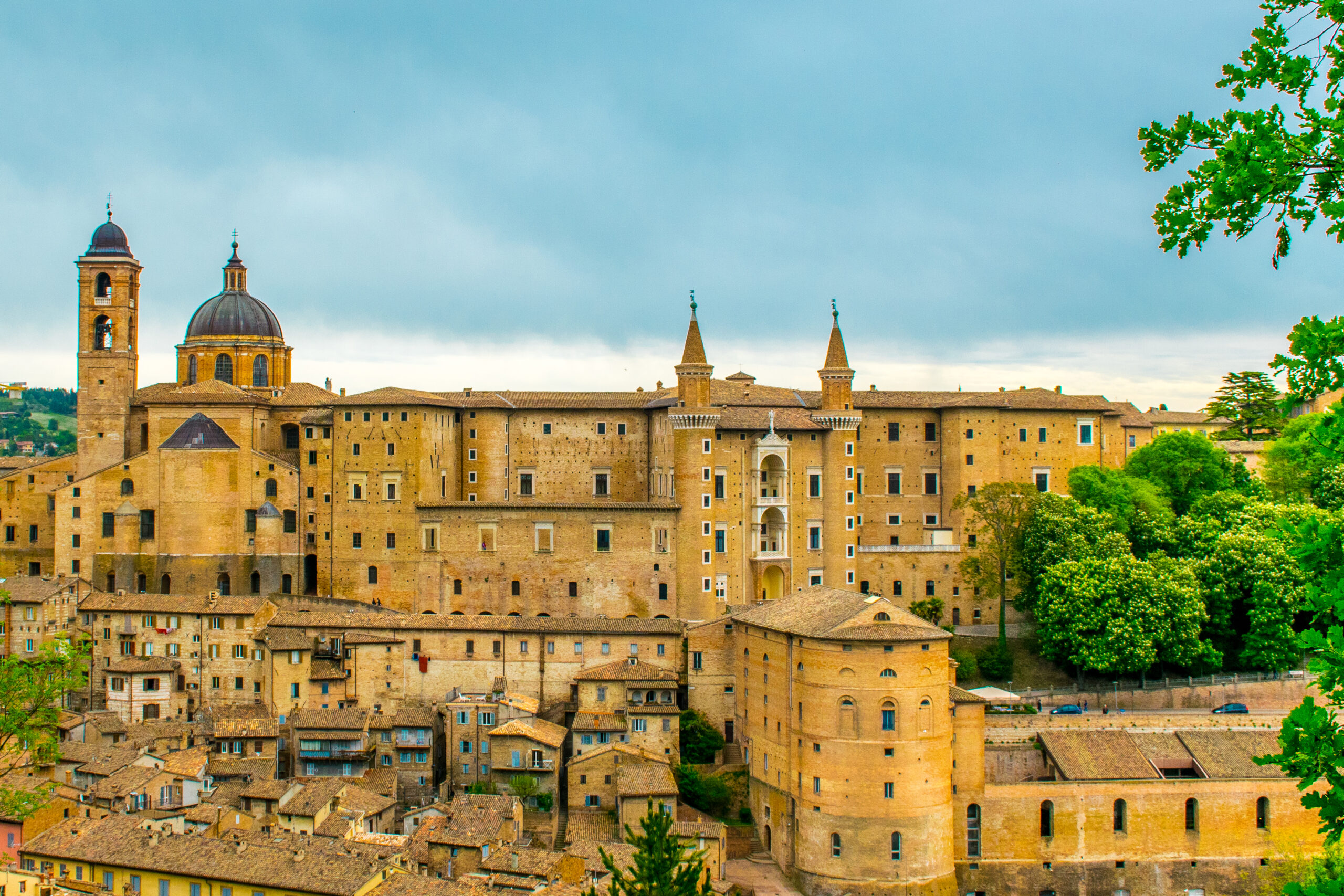
Urbino – Fabriano – Breakfast and transfer to Urbino, one of the Italian capitals of the Renaissance, and guided tour of the fortress, a UNESCO World Heritage site, with the Ducal Palace, a monumental building conceived as a city within a city, the sixteenth-century university, the richly frescoed Oratory of San Giovanni, the neo-classical style Cathedral, and the Albornoz Fortress, an enchanting panoramic viewpoint over the Metauro Valley. Continue toward Fabriano, brief visit of the historic center with Piazza del Comune and Palazzo del Potestà and the imposing Sturinalto fountain and the Loggiato di San Francesco. Check-in at hotel, dinner and overnight stay.
Loreto – Macerata – Ascoli Piceno – Breakfast and departure toward Loreto for a brief stop at the Marian sanctuary famous for its statue of the Black Madonna of Loreto. Continue toward Macerata and visit this Renaissance jewel protected by medieval walls: the Sferisterio, an ancient arena, Piazza della Libertà, overlooked by the Romanesque church of San Paolo, the Palazzo dei Priori, the Loggia dei Mercanti, the Cathedral of San Giuliano with the Clock Tower. Continue toward Ascoli Piceno, the city of travertine and ceramics. Walk at dusk through the historic center with Piazza del Popolo, framed by a loggia of arches and Renaissance palaces. View of the Palazzo dei Capitani del Popolo, the medieval Tower, the Church of San Francesco, and free time for an aperitif at Caffè Meletti, a historic Italian café and Art Nouveau masterpiece. Check-in at hotel, dinner and overnight stay.
Civitella del Tronto – Atri – Breakfast and departure for Civitella del Tronto, visit the Fortress, one of the most imposing works of military engineering in Italy, extending for 500 meters and occupying an area of 25,000 square meters, in a strategic position near the Tronto River. In the afternoon, guided tour of the splendid historic center of Atri with the Basilica of Santa Maria Assunta, which preserves a magnificent cycle of frescoes. On clear days, the panorama embraces, beyond the sea, the entire Gran Sasso chain and the Majella massif. Descending toward the coast, it will be possible to admire the famous “calanchi,” particular natural furrows in the terrain due to its karst nature. Continue toward the Pescara area. Arrival at hotel, check-in, dinner and overnight stay.
S. Stefano Di Sessanio – L’Aquila – Campo Imperatore – Half board at hotel. Transfer to Santo Stefano di Sessanio, an architectural jewel from the medieval period, in a natural setting of rare beauty. Visit the ancient village: the Medici Gate, the Church of Santo Stefano, the crenellated tower, and the characteristic cobblestone alleys of the historic center. Continue toward L’Aquila and guided tour of the city where, after the seismic events of 2009, many monuments have been restored to their former splendor: the evocative Basilica of Collemaggio, the Church of Santa Maria del Suffragio, the Fountain of the 99 Spouts, the historic center, and Piazza del Duomo. Departure for Gran Sasso National Park until reaching the largest plateau of the Apennines, Campo Imperatore, and the Refuge, inaugurated in 1934 and known for having become Benito Mussolini’s prison. Free time to visit this surreal place, surrounded by boundless valleys and majestic nature, the film set of many Western films by Sergio Leone.
Chieti – Sulmona – After breakfast, transfer to Chieti, the ancient Roman Teate is a city of remarkable splendor. Our itinerary
will begin with a visit to the National Museum of Antiquities, which preserves the most important archaeological collection in Abruzzo, including the renowned Warrior of Capestrano. The visit to the historic center will follow the elegant Corso Marrucino, until reaching the Roman Temples, the Marrucino Theater, and the Cathedral of San Giustino. In the afternoon, visit Sulmona with its well-preserved ancient core, characterized as a city linked to love both for confetti, a typical wedding sweet, and for being the birthplace of the Latin poet Publius Ovidius Naso, the refined singer of the Amores, the Ars Amandi, and the Metamorphoses. Continue the visit to the Hermitage of Sant’Onofrio al Morrone, who later became Celestine V, the Pope of the Great Refusal. Located on the slopes of the mountain of the same name, near Sulmona, stands this marvelous hermitage, dating back to the thirteenth century, which jealously guards the memory of Pietro Angelerio (or Pietro da Morrone), the hermit friar who lived here and who first became pope in 1294 with the name Celestine V and then Saint. Check-in at hotel, dinner and overnight stay.
Return – Breakfast and departure for the return journey.